




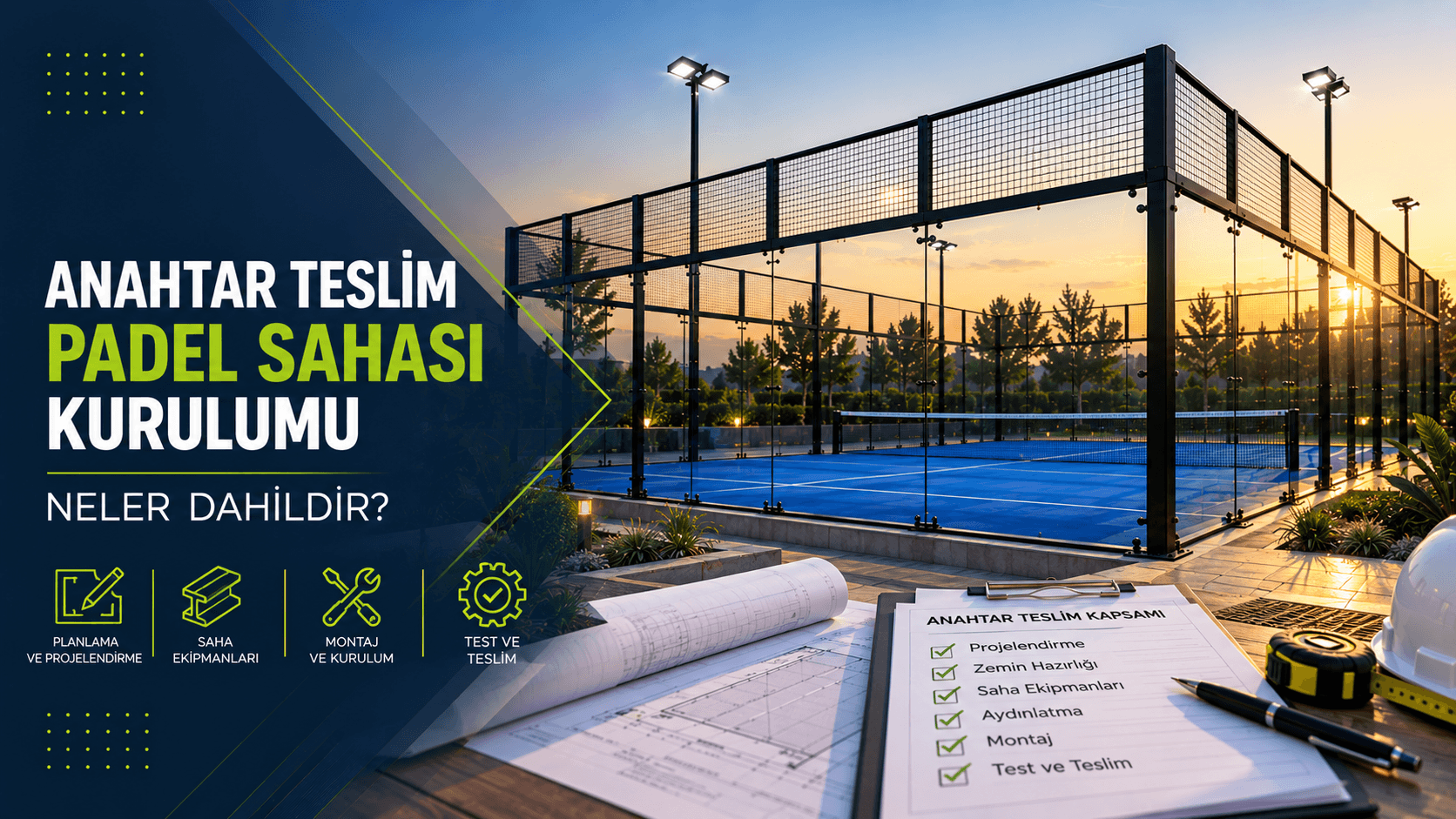
Turnkey padel court installation means completing the design, supply, installation and inspection works defined in the contract and handing over the court ready for use. The structural system, glass and metal enclosure elements, playing surface, net and assembly are generally considered within this scope. Whether groundworks, lighting connections, transport and landscaping are included should be confirmed separately in the quotation.
The key point is that the term “turnkey” does not constitute a scope of work on its own. One quotation may require the client to provide a prepared base, while another may include the groundworks. What matters to the client is having a written agreement from the outset that identifies which works will be complete at handover.
The first stage involves assessing the proposed site and the intended use of the court. Layouts for sports clubs, hotels and private facilities may have different requirements for entrance locations, player circulation and maintenance access. The relationship between courts and other parts of the facility is just as important as the number of courts.
The internal playing area of a standard doubles padel court measures 20 × 10 metres. Layout planning is not limited to these dimensions; surrounding access routes and spaces required for the intended use must also be considered. For indoor courts, usable clear height, beams and other obstructions are also assessed.
The suitability of the base must be confirmed before the court structure is installed. The need for excavation, fill, foundations, concrete and drainage works depends on existing site conditions. If the contract includes these works, their execution method and completion criteria should be defined.
If the client is arranging the groundworks, the court supplier's technical requirements should be provided in advance. Responsibility for checking the base before assembly should also be established. This helps identify the risk of additional work or installation delays caused by an unsuitable surface at an earlier stage.
The steel structure, anchors, glass panels and metal enclosure sections should be treated as a complete system. The quotation should explain the court model, material specifications, protective finishes and connection details. Delivering components to the site and assembling them in the correct sequence are both part of the work.
Glass alignment, joints and surfaces that players may come into contact with should be checked during installation. Sharp projections, loose connections or access openings with unclear clearances should not be left unresolved until after handover. Inspection criteria should be defined in the project documentation.
For a court with artificial grass, the scope may include laying the turf, joining seams, installing court lines and applying the infill required for the selected product. Supplying turf alone is not the same service as handing over a completed playing surface.
The net, posts and tensioning system should also appear on the handover list. Once final surface preparation and net adjustment are complete, the court is checked for use. The operator should be informed of the maintenance procedure appropriate to the installed products.
For a floodlit court, luminaires, columns, installation and court-side cabling should be specified individually. Bringing power from the main distribution board to the court, modifying electrical panels and checking connections may not be included in the same package. If this boundary remains unclear, the court could be complete while its lighting is still unavailable.
Handover checks should assess not only whether the lights work but also their distribution across the court and their effect on players' visibility. The method for verifying the lighting criteria established for the intended use should be agreed in advance.
Transport, unloading, movement of materials within the site and any required lifting equipment should be included in the work programme. Site access, material storage areas and working hours should be discussed before the project begins. The completion schedule should also state conditions such as the base being ready and materials arriving on site.
A canopy or enclosed building, changing rooms, showers, reception, spectator seating, parking and landscaping should not automatically be assumed to form part of court installation. Booking software, camera systems and operating equipment such as rackets may also be separate items. Completing the court and opening the entire facility can represent different scopes of work.
The parties' responsibilities for design documentation, required applications and the coordination of related procedures should also be recorded in writing. The term “turnkey” should not be taken to mean that the contractor will handle all of these processes.
At handover, the completed installation should be checked against the approved design and material schedule. Court dimensions, connections, glass surfaces, entrances, surface joints, lines, the net and any lighting should be inspected together. For outdoor projects, the implementation of the drainage arrangement should also be assessed.
Any outstanding items should be recorded in a handover report with agreed completion dates. Product documentation, operating and maintenance instructions, warranty terms and service contact details should be provided to the operator. This makes handover more than a photographic record of the finished court; it clearly documents what the operator has received.
A warranty defines responsibility for product or installation defects under specified conditions. Routine cleaning, maintenance and wear resulting from use are separate matters. The phrase “warranty included” should therefore not be interpreted as meaning that all maintenance will be provided free of charge. Ask separately about the service scope and any paid maintenance options.
No. Some projects involve installation on an existing prepared base. The scope of work should clearly state whether concrete and other groundworks are included.
A court being ready for use does not mean that other parts of the facility or operational preparations are complete. The opening plan should take all of these activities into account.
Design approval, production, ground preparation, delivery and assembly are interdependent. A realistic programme identifies the conditions for starting work and the tasks each party must complete.
When planning turnkey padel court installation with Padel Spor, you can share details of your available site, the number of courts and any additional facilities you need. Defining the scope at the outset makes the process clearer, from evaluating the quotation to checking the completed installation.