




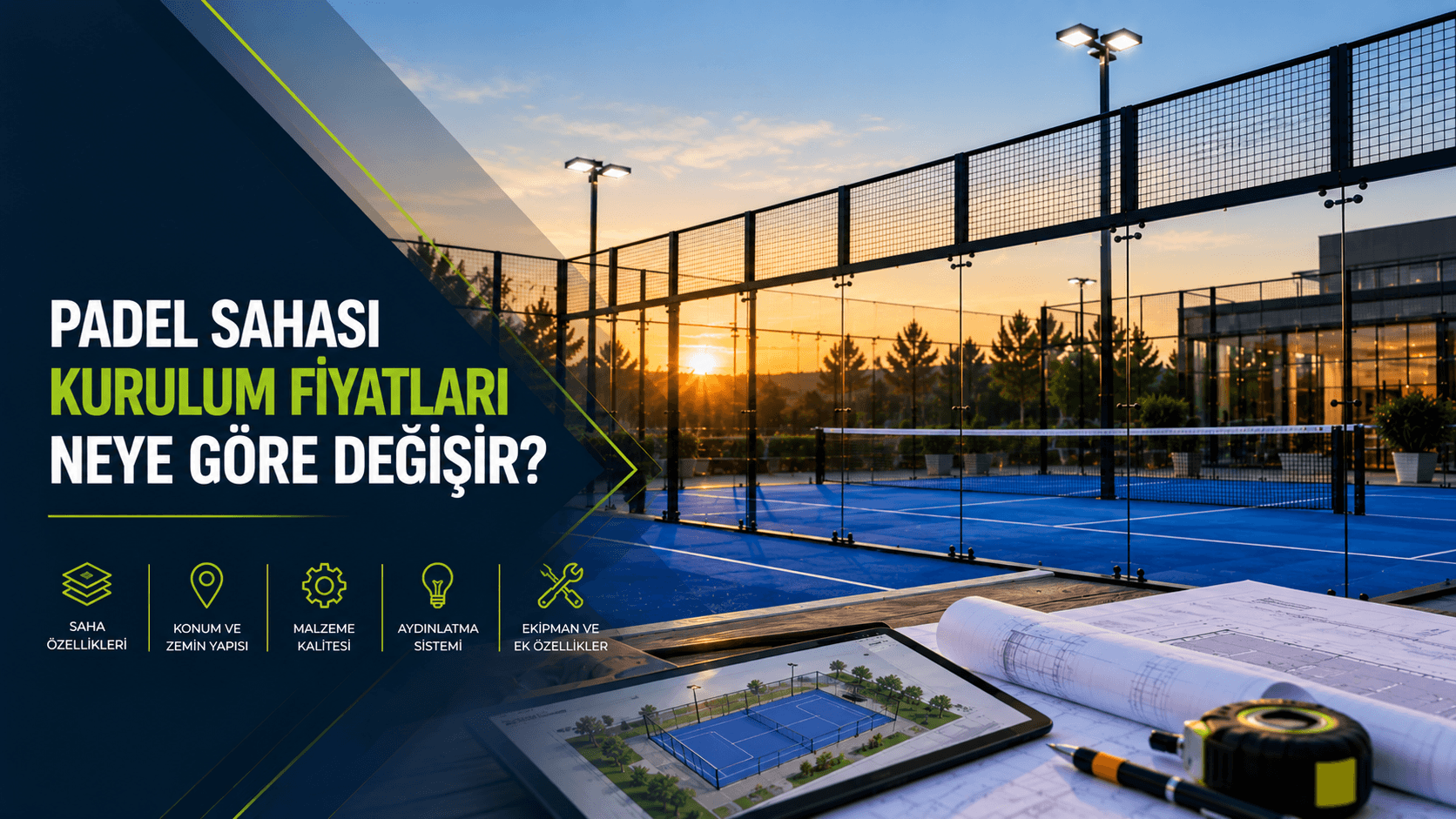
Padel court installation costs depend on existing site conditions, the court model, structural system, glass and playing surface specifications, lighting, transport and the scope of work. It is therefore normal to receive different quotations for two courts of the same dimensions. A meaningful comparison requires looking beyond the total price to understand exactly which works are included.
For example, a court installed at a sports facility with completed groundworks cannot be assessed on the same budget basis as a project on undeveloped land. The first may mainly involve supplying and assembling the court system, while the second also requires excavation, ground preparation, drainage and electrical supply works.
According to International Padel Federation rules, the internal playing area of a standard doubles court measures 20 × 10 metres. However, this 200-square-metre area does not represent the total space required for the facility. Surrounding walkways, entrances, maintenance access and, where applicable, spectator areas must also be considered in the layout.
This distinction matters when pricing a project. Two courts may have identical playing areas, yet one site may already have landscaping and access routes, while the other needs these built from scratch. Requesting a price solely per square metre can conceal this difference.
A site that looks level is not necessarily ready for installation. The load-bearing capacity of the ground, surface regularity, drainage conditions and areas where the court will be anchored require technical assessment. Whether an existing concrete surface can be reused also cannot be confirmed without a site inspection.
Excavation and fill quantities, removal of existing surfaces, new foundations or concrete works and drainage connections can all change the cost. If a quotation states that groundworks are excluded, their scope and the party responsible for completing them should be defined separately.
The differences between standard and panoramic courts go beyond appearance. Glass support arrangements, the positioning of structural members, connection details and installation methods may also differ. When considering a design that provides clearer views, its technical specifications should be assessed alongside its visual benefits.
Steel sections, protective coatings and fixings are significant items in a quotation. Wind exposure requires attention on outdoor courts, while corrosion protection deserves particular consideration at coastal sites. Rather than looking only at steel thickness, ask whether the structural system has been designed for the conditions at the installation location.
The cost of the glass system depends not only on panel specifications but also on fittings, edge finishing and installation details. A quotation that simply states “glass included” does not provide enough information to compare systems. The glass specification and its compatibility with the supporting structure should be clearly described.
For artificial grass, suitability for padel, fibre structure, installation method and the manufacturer's specified infill system are important. Two products of the same colour may have different performance characteristics and maintenance requirements. Check whether the turf price includes adhesive, jointing work, court lines and any required infill.
A lighting budget involves more than the number of luminaires. Columns, mounting equipment, cabling and the point from which electricity will be supplied all affect the total. Luminaire positioning and light distribution are also part of the design because they influence players' visibility.
For example, a court close to an existing distribution board will not require the same electrical work as one needing a supply cable run from a distant point. The quotation should clearly define the boundary between court-side electrical connections and the facility's main electrical infrastructure.
An outdoor court, a covered court and a court inside an enclosed building should be treated as different project scopes. A canopy or building is an additional project with its own structure, foundations, drainage and operating requirements. For installation inside an existing building, the budget should not be finalised before assessing usable clear height and internal obstructions.
The project location, shipping distance and vehicle access affect the installation price. Moving materials into a facility with a narrow entrance may require more planning than delivery to an open, accessible site. Ask whether unloading equipment, lifting machinery and accommodation for the installation team are included.
Installing several courts within the same project may allow some shared costs to be distributed across them. However, a fixed percentage reduction in the cost per court should not be assumed. The layout, extent of groundworks and construction schedule all influence the calculation.
When comparing two quotations, first ensure that they specify equivalent court models and technical features. Then compare groundworks, assembly, delivery, electrical works and aftercare. A lower total may reflect certain tasks being left to the client.
The currency, quotation validity period, VAT treatment and payment stages should also be stated in writing. Warranty coverage should be distinguished from paid maintenance services, with clear information about which components are covered and under what conditions. Cleaning, maintenance and future refurbishment requirements should be considered alongside the initial installation cost.
The installation location, planned number of courts, site dimensions, current photographs and information about the existing ground help with the initial assessment. You should also provide your preference for outdoor or indoor use, the desired court model and your target opening period. These details form the basis of a preliminary quotation, although a technical inspection may be needed to establish the final scope.
If its suitability is confirmed, it may reduce some new groundwork requirements. However, any necessary repairs, levelling or alternative anchoring solutions will be priced separately.
No. The choice should reflect the facility's intended use, spectator requirements, architectural approach and budget. Appearance alone should not determine the decision.
A figure without a defined scope, date or installation conditions offers only limited guidance. A project-specific quotation should be reviewed together with its inclusions and exclusions.
When discussing your project with Padel Spor, you can start by sharing your site details and intended use. This helps clarify the items that make up the padel court installation cost and allows different options to be compared against the same requirements.