



The rapid growth of padel around the world is creating new investment opportunities for sports facilities and social living spaces. Padel courts are increasingly being included in hotels, sports clubs, residential developments and municipal facilities. However, finding a suitable location alone is not enough to create a successful facility. A professional padel court installation requires several components to be considered together, including accurate planning, durable steel construction, safe glass systems, a suitable playing surface and balanced lighting.
The decisions made during the installation process directly affect the playing quality, service life, maintenance requirements and operating costs of the court. For this reason, every project should be planned according to the characteristics of the available area and the intended business model.
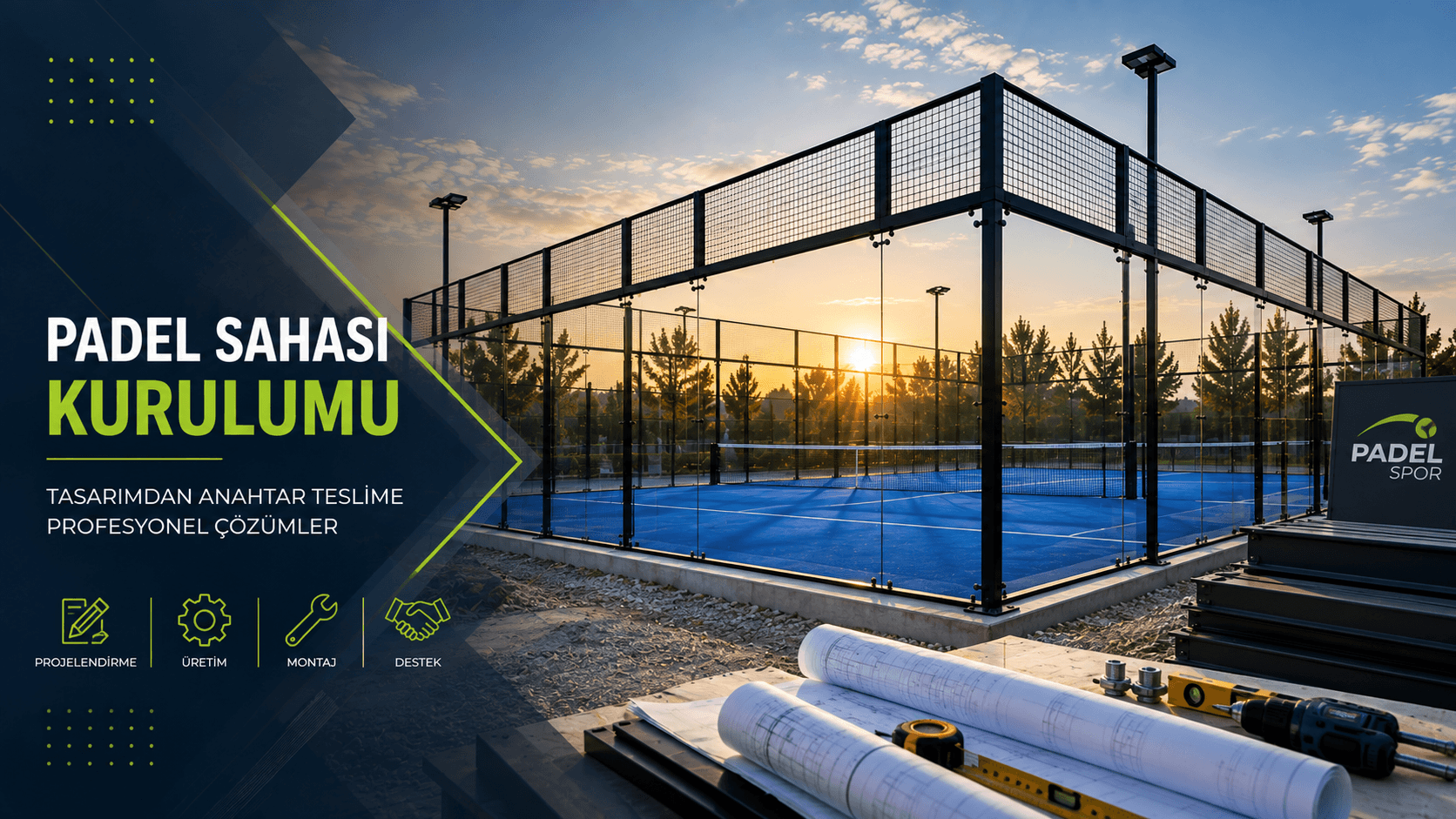
A padel court is a playing area designed specifically for padel, featuring an artificial turf surface surrounded by tempered glass and metal mesh systems. Unlike a tennis court, the glass walls and metal surfaces form an active part of the game, allowing players to continue rallies by playing the ball off the surrounding structure.
A standard padel court playing area is generally 10 metres wide and 20 metres long. However, additional space may be required for safety zones, entrances, lighting posts, pedestrian access and spectator areas around the court.
A professional padel court project consists of several interconnected stages. Each stage must be completed in accordance with the technical requirements of the project to achieve a safe, durable and high-performance result.
Before the padel court installation begins, the proposed site is examined in detail. The existing ground condition, available dimensions, drainage requirements, prevailing wind direction, sunlight exposure, surrounding structures and electrical infrastructure are evaluated.
For outdoor projects, it is particularly important to ensure that rainwater can be removed from the court and that water does not accumulate on the playing surface. For indoor courts, ceiling height, ventilation, structural columns and lighting possibilities should also be considered.
The site survey determines whether the area is suitable for padel court construction and identifies the main technical requirements of the project.
Not every padel court is designed for the same purpose. A facility intended for recreational use may have different requirements from a professional venue that will host tournaments. Therefore, the court model should be selected by considering the operator’s target audience, expected usage intensity and available investment budget.
The following details are defined during the planning stage:
Accurate project planning helps prevent measurement, infrastructure and installation problems before construction begins.
A padel court requires a strong and level base to provide long-term performance. Once the necessary excavation, filling and ground-compaction work has been completed, the concrete foundation can be prepared.
A visually flat concrete surface is not sufficient on its own. Outdoor courts require an appropriate slope and drainage solution so that rainwater can be removed efficiently. Differences in ground level may eventually cause uneven areas in the artificial turf and negatively affect the playing experience.
Correct installation of the structural anchors is also essential for court safety. The groundwork should therefore be completed according to the structural characteristics and engineering requirements of the selected padel court system.
The supporting framework surrounding a padel court is generally manufactured from steel. This structure supports the tempered glass, metal mesh panels, access doors and, in some court models, the lighting posts.
Material thickness, welding quality and protection against corrosion should be considered during the production of the steel components. Durable paint or coating systems are particularly important for outdoor padel courts exposed to rain, humidity, sunlight and temperature changes.
During installation, the structure must be secured to the ground at the correct anchoring points. All joints and connection components should also be technically inspected to ensure safe use.
The glass surfaces are an active part of padel. As players continue rallies by rebounding the ball from the glass, the panels must be both safe and suitable for the dynamics of the game.
Tempered safety glass is generally preferred for padel courts. The thickness, dimensions and fixing method of the glass are determined according to the selected court design. Suitable connection and support components should be used between the glass panels and the steel structure during installation.
Incorrect glass installation may cause vibration, excessive noise, loose connections and safety risks. The glass assembly should therefore be completed by an experienced installation team.
Metal mesh panels are used in specific sections of the court as a continuation of the glass walls. These panels help keep the ball inside the playing area while also functioning as active playing surfaces.
The mesh spacing, wire thickness and connection to the supporting structure must be planned carefully. The finished surface should not contain sharp points or exposed components that could harm players. Corrosion-resistant materials and protective coatings should be used for outdoor courts.
The playing surface is one of the most important elements affecting padel court performance. The selected artificial turf directly influences ball bounce, player movement and grip.
During installation, the turf rolls must be laid in the correct direction, the joints must be connected properly and the surface must be prepared evenly. Using the appropriate amount of infill sand helps support the turf fibres and allows the playing surface to achieve the intended performance.
For commercial facilities with high levels of use, choosing durable and easy-to-maintain artificial turf can help reduce long-term operating costs.
Courts that will be used during evening hours require a balanced and uniform lighting system. High light output alone is not sufficient. The system should minimise shadows, avoid glare and allow players to follow the ball comfortably throughout the court.
The power, beam angle, mounting height and position of the lighting fixtures should be evaluated together. LED lighting systems are commonly preferred for padel courts because of their energy efficiency and relatively low maintenance requirements.
Facilities intended for professional competitions or broadcasting may require a different lighting design from courts intended primarily for recreational use.
Outdoor padel courts allow players to enjoy the game in natural conditions and can provide an effective investment model in regions with suitable climates. However, rain, wind, sunlight and temperature changes may affect court availability. Drainage, corrosion protection and wind loads therefore become especially important in outdoor projects.
Indoor padel courts can be used throughout the year and may provide businesses with more consistent booking opportunities. When planning an indoor facility, ceiling height, ventilation, indoor temperature, acoustics and artificial lighting should be evaluated separately.
An existing outdoor court can also be covered at a later stage. If this possibility is considered during the initial planning process, the foundations and structural systems can be prepared to accommodate a future roof or enclosure.
Padel courts can be developed as independent sports investments or added to existing facilities to increase their value. Common installation locations include:
When choosing a location, investors should consider not only the physical suitability of the site but also accessibility, parking facilities, local population, target audience and sporting habits in the surrounding area.
The cost of a padel court installation varies according to the technical specifications of the project. It is therefore difficult to provide a reliable fixed price before the site has been evaluated and the project requirements have been defined.
The main factors affecting the total investment cost include:
When comparing quotations, investors should look beyond the initial purchase price. Material quality, installation experience, warranty conditions, maintenance requirements and after-sales support should also be taken into account.
The installation period depends on the number of courts, the existing ground conditions, the selected court model and the project location. A court installed on a completed concrete base will not have the same construction schedule as a project that requires excavation, drainage and complete infrastructure preparation.
Production planning, weather conditions, transport distance and custom design requirements may also affect the delivery schedule. A realistic project timeline can be prepared after the site survey has been completed and all technical details have been confirmed.
The following points should be considered when planning a safe, durable and efficient padel court:
Low-quality materials or incorrect installation may initially appear economical. However, they can lead to additional costs over time due to loose glass connections, surface deformation, corrosion and lighting problems.
Regular maintenance helps protect the playing performance of a padel court and extends the service life of its components. The artificial turf should be cleaned periodically, the fibres should be brushed using suitable equipment and the distribution of infill sand should be checked.
Glass surfaces should be cleaned with appropriate products. Structural connections, entrance doors, metal mesh panels and lighting systems should also be inspected at regular intervals. For outdoor courts, rainwater channels and drainage outlets must be kept clean.
Maintenance frequency should be determined according to court usage and the climate conditions of the project location.
When choosing a padel court construction company, investors should evaluate more than the quoted price. The company’s ability to manage the complete project should also be considered. Coordinating design, production, infrastructure, installation and after-sales support through a single project plan can make the process more efficient.
The company’s completed projects, manufacturing capabilities, material quality and technical support services should be reviewed. Logistics and international assembly experience are particularly important for projects located in different cities or countries.
Padel Spor manages the design, production and installation stages of padel courts as an integrated process, providing solutions tailored to different investment requirements. Indoor and outdoor court options can be planned according to the project location, expected usage intensity and business objectives.
The standard playing area measures 10 x 20 metres. However, additional space should be planned for the court structure, safety zones, access points, lighting systems and surrounding landscaping.
Yes. A padel court can be installed outdoors. Ground drainage, structural protection and local weather conditions should be considered during the planning and construction stages.
If the dimensions and infrastructure are suitable, an existing tennis court may be converted into one or more padel courts. The exact number of courts can be determined after a professional site survey and feasibility assessment.
Artificial turf systems developed for padel are generally used. The fibre structure, infill system and installation quality influence ball bounce, grip and player movement.
Yes. Padel courts can be covered using steel roof structures, membrane systems or other project-specific enclosure solutions. Structural loads, clear height and ventilation requirements should be planned according to engineering calculations.
A properly planned padel court installation can provide long-term use and revenue potential for sports investments. The compatibility of all components, from the foundation and steel structure to the glass system and artificial turf, supports both player satisfaction and sustainable facility operation.
Contact Padel Spor to request a technical assessment for your planned facility and receive a customised quotation based on the selected court model, site conditions and project requirements.