


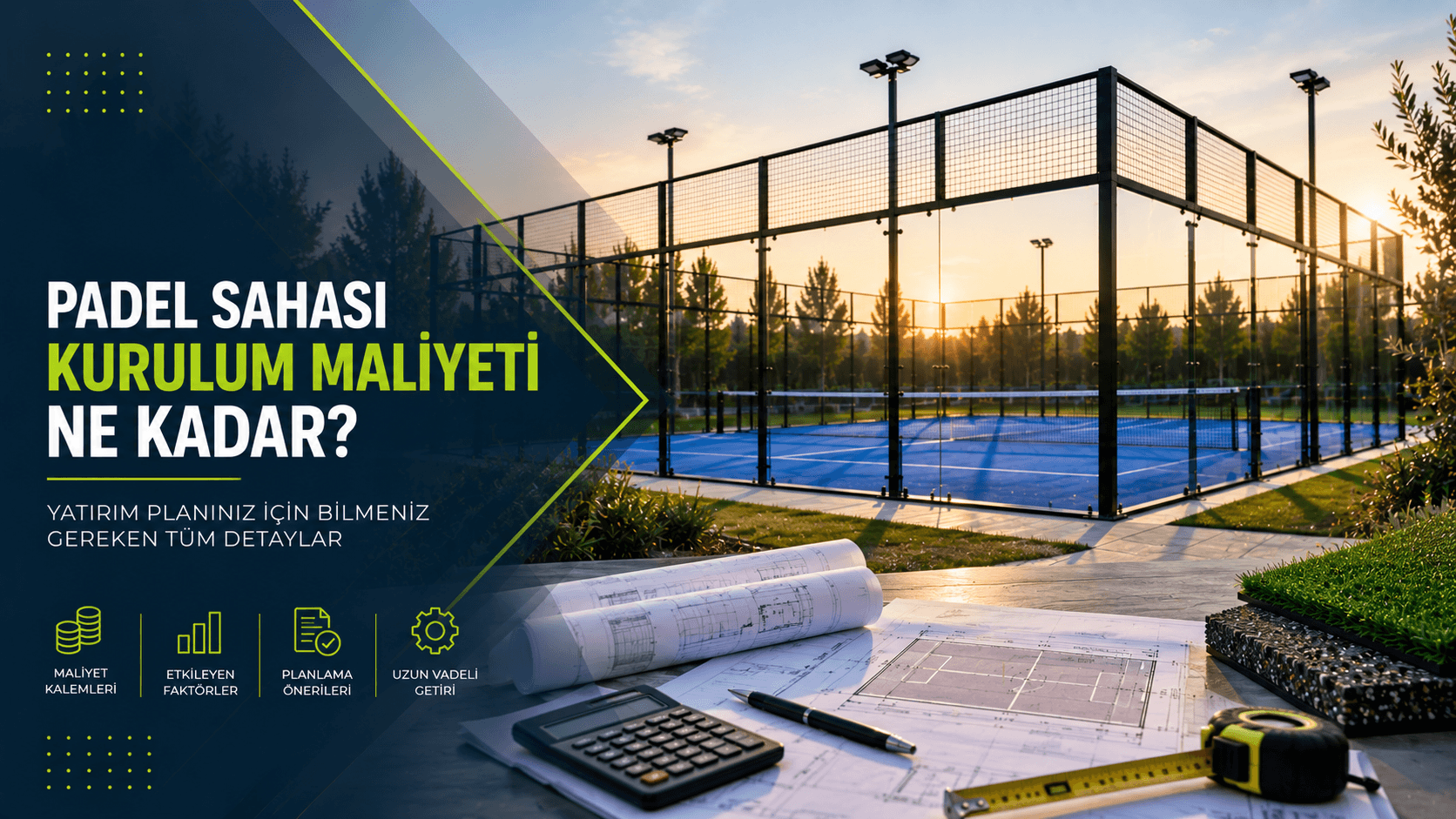
The padel court installation cost varies depending on the selected court model, existing ground conditions, steel and glass systems, artificial turf quality, lighting requirements and project location. For this reason, it is not possible to provide a single price that applies to every project. A standard padel court installed on a prepared surface will not have the same investment cost as a covered panoramic court requiring complete groundwork.
For an accurate cost calculation, investors should consider more than the price of the court structure. Concrete foundations, drainage, electrical infrastructure, transportation, installation and landscaping should also be included in the total project budget.
A professional padel court is a comprehensive project involving much more than assembling glass panels, steel components and artificial turf. When preparing a quotation, all work required to make the court ready for use should be identified.
The main elements included in the cost of padel court installation are:
Not every project requires all these elements to the same extent. If the existing surface is suitable or the electrical infrastructure has already been prepared, the overall installation cost may be reduced.
One of the most important factors affecting padel court installation cost is the selected court model. Standard, panoramic and purpose-built padel court systems have different structural and glass configurations.
Standard padel courts usually have more visible supporting posts. Panoramic models are designed to reduce structures that restrict visibility and generally feature larger glass surfaces. This design may provide advantages in terms of spectator experience, professional events and the overall visual appeal of the facility.
Panoramic courts may require a higher investment than standard models due to their specialised structural design, larger glass panels and more detailed connection systems. The court should therefore be selected according to its intended use rather than appearance alone.
If the installation area already has a prepared and level concrete surface, the required groundwork may be limited. However, when a padel court is built on undeveloped land, a separate budget will be required for excavation, filling, compaction, concrete, drainage and surrounding site improvements.
Outdoor courts require the correct surface gradient to prevent rainwater from accumulating on the playing area. Insufficient drainage may cause water to collect beneath the artificial turf and damage the playing surface over time.
The main factors affecting ground preparation costs include:
Quotations prepared without examining the site may exclude important requirements, leading to additional costs after construction has started.
The steel structure forms the main supporting system of a padel court. Glass panels, metal mesh sections, entrance doors and, in some models, lighting posts are installed on this structure. The dimensions of the steel profiles, material quality, welding workmanship and connection components therefore have a direct effect on the price.
For outdoor courts, the structure must be protected against rain, humidity, temperature changes and other environmental conditions. Reducing the quality of paint or protective coatings may lower the initial quotation, but it can increase future maintenance costs caused by corrosion, repainting and component replacement.
Projects located in coastal regions, highly humid environments or areas exposed to strong winds may require different technical solutions from standard installations.
Glass panels do more than surround the court; they are also an active part of the game. As the ball rebounds from the glass and returns to the playing area, the dimensions, thickness, surface quality and fixing method of the panels are important.
Tempered glass systems are generally used for safety in padel courts. Panoramic designs often use larger panels, which may increase both material costs and installation requirements. Safe transportation and on-site handling of the glass are also important parts of the logistics plan.
The cost calculation should include not only the glass panels but also seals, fixing components and professional installation work.
Artificial turf is the surface with which players have direct contact. It should therefore not be selected solely according to colour or price per square metre. Fibre structure, yarn quality, density, backing properties and suitability for the expected level of use all affect playing performance.
Artificial turf that is not suitable for padel may cause inconsistent ball bounce, excessive slipperiness or premature surface wear. The amount of infill sand and its even distribution across the court are also important factors during installation.
For commercial facilities expecting high booking volumes, investing in a durable playing surface may increase the initial padel court cost but reduce maintenance and replacement expenses in the long term.
A significant proportion of padel court bookings take place during the evening. Lighting should therefore be considered an essential operating requirement rather than an optional visual feature.
The following factors are considered when calculating lighting costs:
Using high-powered fixtures alone is not sufficient. Light should be distributed evenly across the playing area without creating shadows or disturbing players’ vision. A correctly designed energy-efficient system can also help control the facility’s long-term electricity costs.
An outdoor padel court can be completed by installing the court system on a suitable foundation. An indoor padel facility may also require a roof or enclosure, supporting structure, rainwater management, ventilation and, where necessary, climate control.
If the court will be installed inside an existing building, the clear ceiling height, column spacing, ground condition and fire safety requirements should be evaluated. If a new indoor facility is to be constructed, the cost of the building should be calculated separately from the padel court installation budget.
If an outdoor court may be covered in the future, it is beneficial to make this decision during the initial planning stage. The concrete foundation and structural system can then be designed to accommodate a future enclosure.
A single-court facility and a multi-court padel centre do not have the same cost structure. When several courts are installed at the same location, transportation, team mobilisation, certain infrastructure works and shared social areas can sometimes be planned more efficiently on a per-court basis.
However, as the number of courts increases, the capacity of parking areas, reception facilities, changing rooms, showers, waiting areas and cafés may also need to be increased.
Commercial projects should begin by answering the following questions:
These questions determine not only the initial investment cost but also the facility’s future expansion capacity.
Padel courts consist of steel components, large glass panels, metal mesh systems, artificial turf and numerous connection elements. The distance between the manufacturing facility and the project location affects the transportation method and logistics cost.
When calculating installation costs, the number of courts, site accessibility, lifting equipment requirements, accommodation and installation schedule should be considered. International projects may also involve customs procedures, international transportation and local site conditions.
If the court is located in a restricted area or heavy vehicles cannot reach the installation site, additional handling and labour may be required.
Quotations from different companies should not be compared solely according to the total price. A lower-priced quotation may exclude the concrete foundation, artificial turf, electrical infrastructure, transportation or installation.
For an accurate comparison, the following details should be clearly stated in the quotation:
Comparing two quotations based only on price may be misleading if they do not include the same products and services.
A padel court is a long-term commercial investment. Using lower-quality steel, insufficient surface protection, unsuitable artificial turf or poorly designed lighting may create higher costs in the future.
If a court frequently has to be closed for repairs or maintenance, the facility may lose potential bookings and revenue. For this reason, investors should evaluate the total cost of ownership rather than focusing only on the initial purchase price.
The total cost of ownership may include:
A court installed with suitable materials and maintained regularly can provide a more predictable operating cost throughout its service life.
The most effective way to control costs is to plan the project correctly rather than compromise on technical quality. Avoiding unnecessary work and anticipating future modifications can help the available budget be used more efficiently.
The following steps may help control the installation budget:
Reducing costs in the wrong areas may result in higher repair and replacement expenses in the future.
Before an accurate padel court installation price can be calculated, the main project details must be collected. Photographs and measurements of the site, existing ground conditions, number of courts, preferred court model and project location are required for the initial assessment.
More complex projects may require an on-site survey. Following the survey, groundwork requirements can be identified, technical specifications can be confirmed and a detailed quotation can be prepared. This allows the investor to see clearly which products and services are included in the price.
No. The price is calculated specifically for each project because the court model, ground conditions, infrastructure requirements, project location and selected materials may vary.
This depends on the scope of the quotation. In some projects, the concrete foundation is prepared by the investor. In others, it may be included as part of a turnkey installation service. This item should be clarified when requesting a quotation.
Panoramic courts may require a higher investment than standard models because of their larger glass surfaces and specialised supporting structures.
Indoor projects may require a roof, supporting structure, ventilation, lighting and other building-related systems in addition to the court itself. These additional works increase the total project budget.
Operating expenses may include regular cleaning, artificial turf maintenance, redistribution of infill sand, structural connection inspections, lighting consumption and the replacement of certain components over time.
To calculate an accurate padel court installation cost, all project details should be evaluated together. A realistic investment budget can be prepared once the existing site conditions, court model, intended use and business objectives have been established.
Padel Spor plans site assessment, project design, manufacturing, artificial turf installation and professional assembly according to the specific requirements of each project. You can request a customised technical assessment and quotation by providing the location, dimensions and planned number of courts for your project.